

Introduction
The 15th China Five year plan has been released and it’s extremely compelling. It contains an important shift in focus that was eluded to in the 14th China Five year plan and has profound ramifications for all of us. China is moving to secure it’s food sovereignty and that will affect the entire globe.
Systemiq’s Report Summary
Much of this post discussion stems from the report called “China’s Food Future” by the thinktank Systemiq. It’s an excellent read with profound insights.
Situational Awareness
It’s clear that China wants to ensure the prosperity of its own people. Prior successive Five year plans have been laying the foundations for that prosperity, and now they shifting their focus and their attention to their food security.
We’ve seen in recent years how food insecurity can give rise to society instability. And now with geopolitical shocks like wars, supply chain disruptions, climate change and sanctions becoming more prominent, food insecurity and food prices, will lead to national instability. China clearly sees food insecurity as a problem is now taking concrete decisive steps to address this.
Because of the economic success that China has had in recent years, in particular bringing 800 million people out of poverty, the Chinese now have a substantial middle class. Moving into the middle class brings with it new behaviors like more food consumption and in particular meat consumption. This is evidenced by the fact that over the past four decades China added 450 million new mouths to feed; and rising incomes has led to a ten fold increase in meat consumption and a 55% increase in per-capita food consumption. In order to accommodate this increased appetite, China moved from being a minor food exporter to a gigantic importer of food in particular soya and maize(for their own livestock) as well as beef(because their own internal meat production isn’t enough).
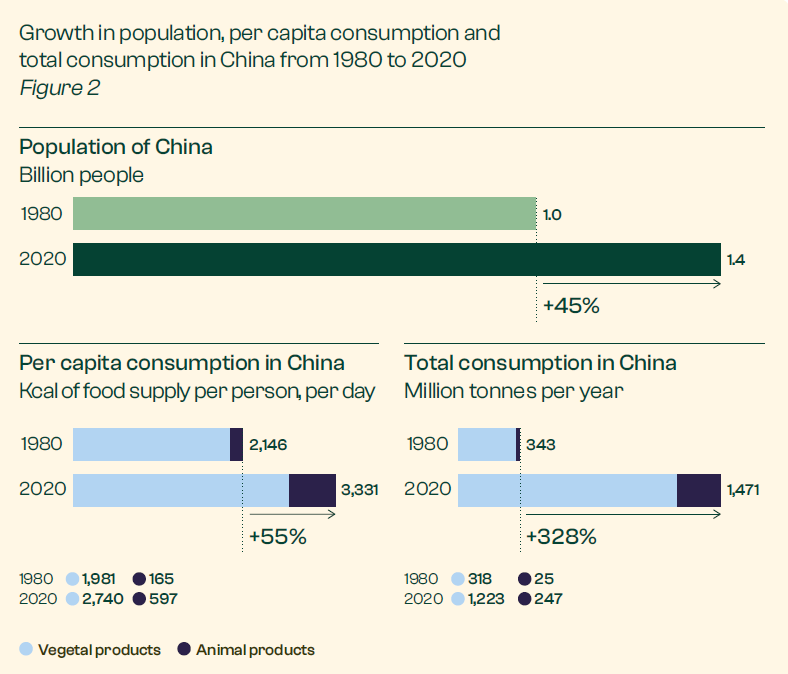
This enormous need for more soya, maize and beef from countries like the USA, Brazil and Argentina creates a massive dependency risk.
“In the three years from 2021 to 2023, China was the primary destination for the vast majority (89%) of soya exports from Argentina, 71% of Brazil’s soya exports, and 53% of the US’s soya exports.”
– “China’s Food Future” Report
At any point, USA could decide to withhold it’s soya exports to induce societal instability in China via increased food prices. This isn’t hard to imagine given USAs hotgun tariffs and sanctions in recent years at practically all world nations friend and foe alike.
“In response to these mounting pressures, Chinese leadership has elevated food security to a core strategic priority.”
This massive dependency risk is something China will mitigate. So what solutions is China exploring?
The Food Technical Solutions
China is taking a wide, sweeping, holistic approach to solving the food security issue. They’ll be implementing everything from traditional agriculture optimization to nascent food technology to gain food sovereignty. These are the broad categories they’re looking at are:
1. Alternative Proteins & Biomanufacturing Infrastructure
- Precision Fermentation: Micro-organisms are genetically engineered to express specific functional proteins (such as whey or albumin) which are then extracted and purified.
- Biomass Fermentation: Micro-organisms (including fungi, bacteria, and yeast) are cultivated at scale to harvest protein-rich microbial biomass in controlled settings with minimal land and water use.
- Cultivated Meat: Animal cells are grown directly inside industrial bioreactors, targeting long-term commercial viability to substitute for conventional livestock production.
- Plant-Based Alternatives: Crops such as soya, peas, rice, and wheat are processed into functional ingredients and foods that mimic animal-based meat and dairy.
- Bioreactors & Processing Hardware: Strategic state investment focuses on domestic production of bioreactors, fermentation systems, enzyme production lines, and precision bioprocessing equipment to ensure control over critical biomanufacturing hardware.
2. Crop Biotechnology & Farmland Infrastructure
- GM and GE Crop Adoption: Controlled commercialization of genetically modified (GM) and gene-edited (GE) maize and soya varieties to enhance stress resistance and achieve projected yield improvements of 6–13% of local crops.
- High-Standard Farmland (HSF) Construction: A state-led infrastructure program to upgrade core arable land with improved soil, irrigation, drainage, mechanization access, and digital management, aiming to raise High-Standard Farmland coverage from 56% in 2024 to 75% by 2030.
3. Feed Reformulation & Vertical Livestock Farming
- Soya Bean Meal Reduction: Mandated restructuring of livestock feed formulas to lower the inclusion of soya bean meal from 14.5% in 2022 to under 10% by 2030 without reducing meat output.
- Controlled-Environment Vertical Farming: Building multi-storey, highly automated livestock facilities (such as pig towers) to maximize land efficiency, enforce biosecurity, and deliver an 11% improvement in feed conversion ratios.
4. Species Shift & Smart Farming
- Poultry and Aquaculture Expansion: Accelerating a pivot toward species with higher feed efficiency and lower land intensity, supported by recirculating systems and offshore aquaculture facilities.
- Digital & Smart Agriculture: Policy deployment under the Digital Agricultural and Rural Development Plan and National Smart Agriculture Implementation Plan to modernize rural farming practices.
5. Supply Chain Efficiency & Trade Diversification
- Food Loss and Waste Reduction: Legally enforced, whole-supply-chain actions from harvest through to final consumption to reduce waste, effectively expanding food supply without extra land or inputs.
- Import Sourcing Diversification: Securing new trade partnerships with emerging producers (such as Ethiopia and other African nations) while enforcing stricter quality, sustainability, and traceability standards on imported commodities.
The Policy Solutions
Based on the report, China will be implementing the exact same playbook that allowed them to become dominant in solar, wind, batteries(SWB) and electric vehicles(FSD, AEV). They’ve already figured out a process of mass scaling that works, and they will maximize that process with respect to their food sovereignty goal.
With respect to SWB and EVs, they implemented a strategic, coordinated plan of
- Governmental financial support
- Policy and regulatory support and
- Induced demand.
These initiatives are stringently directed from the central government, and those directives flow to provinces below. The provinces themselves have a lot autonomy in how they achieve these goals, and they work with entrepreneurs to achieve the central government targets. The central government tells you what to do, and you have the freedom to figure out how to make it work. The consistent feedback loops amongst the central government, provinces and entrepreneurs allows for adjustments to stay on target.
This is the exact same play book they’ll use with respect to all the Food Technology Solutions. They will apply 1) governmental financial support 2) policy and regulatory support and 3) induced demand to the food technologies mentioned above. So what does it mean for us.
The Implications for the World
What China does affects the world now. If they’re making such broad sweeping changes to how they manage food, then that’s going to affect large and small nations in significant ways. Here are some broad changes that are likely to occur.
Near Term
In the near to mid term, Argentina, Brazil and the US can say goodbye to their massive export profits from their soya, maize, beef and everything else. The flip side of this, is that smaller nations in the interim like South Africa could be in a position to benefit should China diversify their feed stocks(soya, maize).
Mid Term
In the mid term, we all could see our local national food production wholly destabilized if we don’t prepare accordingly. When China figures out precision fermentation, cellular agriculture and biomanufacturing at scale and reduced cost, they will export products based on these technologies the same way they did with solar and electric vehicles. I envision a hopeful future where our local SMMEs could be producing massive quantities of all manner of meat with medium size bioreactors. In fact I suspect that even restaurants will buy these bioreactors and create the meat for customers on site in a transparent manner, while feeding the bioreactors with crop meal from crop farmers who were smart enough to pivot.
I already have a Chinese solar system, electric vehicle and borehole pump; and even though I’m vegetarian I will gladly buy meat from these processes. I speculate that livestock and poultry farming around the world will collapse, but crop farming will expand because the meat makers will still need feed crop stocks for the fungi, bacteria, yeasts and bioreactors as mentioned above.
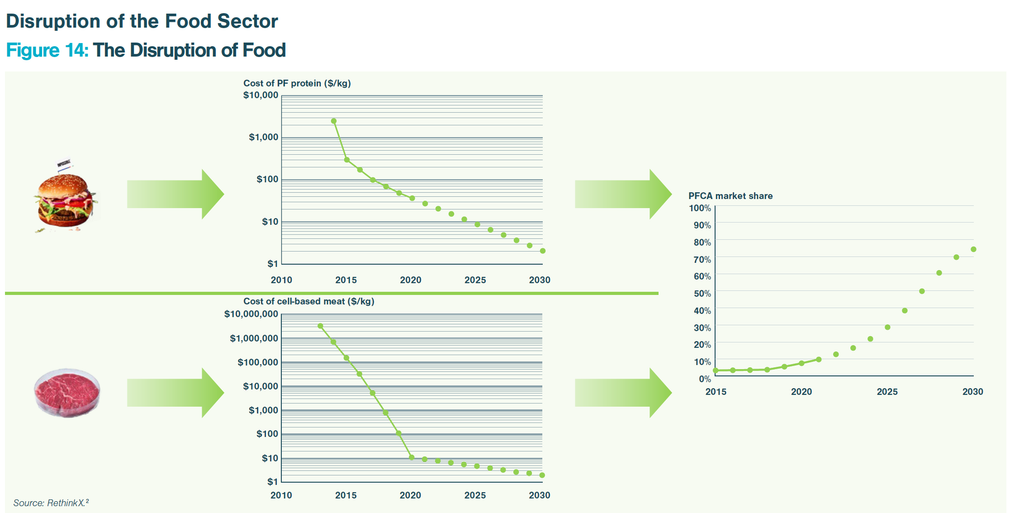
Last year Precision Fermentation meat hit price parity with high-end restaurant meat. The cost of producing Precision Fermentation fell from $10,000 in 2010 to $2.50 last year. The cost of producing Cultivated Meat fell from $5,000,000 in 2010 to $10 in 2020. By the end of this decade traditional meat will be over priced, listeriosis-ridden and bland compared to dirt cheap everyday wagu beef delivered by biomanufacturing at a moments notice.
If you’re in livestock or poultry farming, better move over to crop farming.
Long Term
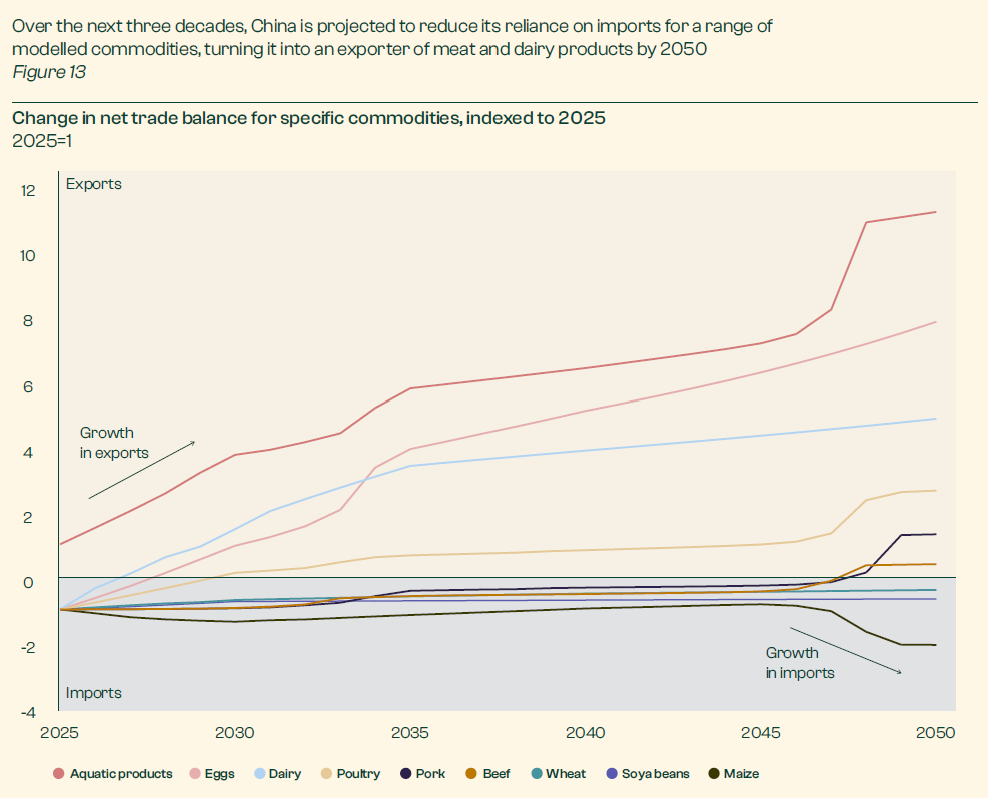
In the long term, China will become a massive exporter of food and potentially decimate other nations abilities to produce certain kinds of food. Unless of course those nations have prepared adequately. A possible positive of this glut of food coming from China, is that global hunger and starvation could likely becoming a thing of the past with no child ever having to go hungry.
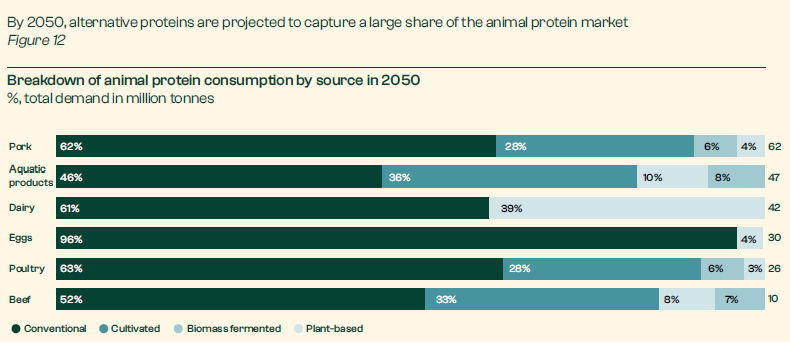
The thing that really interests me is this. Animal slaughter could go the way of the dodo. Having to kill animals for meat could actually become an ultra niche activity. It will be seen as archaic as blood letting, living in caves or carrying gold around in your pocket.
NOTE : This one possibility horrifies me though. I made mention earlier of the highly automated livestock facilities or pig towers. We all know how egregious CAFOs(Concentrated Animal Feeding Operations) are. Animals are confined to tiny cages for the entirety of their existence living in their own excrement and squalor all the while being pumped full of prophylactic antibiotics and drugs. Now imagine taking that single level operation and staking 26 on top of another. Now imagine being the pig in the center of the bottom level with countless other pigs in squalor above you in 26 floors. If that isn’t a unique kind of hell, I don’t know what is. This is something that should be stopped.
We’ll see a indescribable amount of animal suffering for the next few decades, followed by virtual none thereafter.
A plant based future
Humanity has always had plants at the center of its diet. It’s only with the proliferation of mass transport(railways), refrigeration(long term storage) and large scale CAFO operations that meat become central to modern diets due to the low cost and high ubiquity. Now in a weird ironic sense technology will take us back to having plants at the center of our diets albeit in a new way. Crops will become the feed for the bacteria, fungi and yeast that in turn produce our meat. More people will farm crops and live off the land.
Prepping for that future
As South Africans we should all prepare for this future lest we find ourselves in further hardship. Here are some ideas of the top of my head:
- Our livestock and poultry farmers should move over to farming crops to handle the forthcoming demand from China, and simultaneous prepare to provide feed for the bioreactors that will create the alt protein. Livestock farmers will get decimated, either by the increasing number of animal viruses(listeriosis, mad cow, foot and mouth, bird flu, swine flu, etc) or priced out by the cheap clean meat coming out of China.
- Our beer producers can also benefit greatly. Their skills in fermentation can transfer over to Precision Fermentation of alt meat opening more markets locally and internationally. They should prepare for new markets to open up to them.
- The bioreactors and other biomanufacturing infrastructure will require massive amounts of energy so building out our solar, wind and battery infrastructure will be absolutely necessary. Taking the steps now to put this infrastructure in place would be wise. In one fell swoop you could have a solar farm, meat farm and beer operation all in one.
- This technology could also form the basis of new medical treatments, if you can grow meat with precision fermentation or as cultivated meat, then you could also grow human skin for burn victims, cartilage for osteoporosis or even small simple tissues like corneas for transplants. Given our decent medical research capabilities in South Africa, providing platforms for these technologies could turn us into a medical hub powerhouse for all of Africa.
Conclusion
We’ve seen what happens when China puts its mind to something.
Seventy years ago Mao ZeDong, speculated that it would take 70 years for China to reach the technological parity of the West. Fourteen Five year plans later i.e.70 years later it appears Mao ZeDongs speculations have come true. This prediction is uncanny in it’s accuracy, and it leads me to think that Chinas next set of plans isn’t just talk, they’ve perfected the process, ironed out all of the kinks and are now executing with deliberate efficiency. So I believe these food security predictions will come to pass. It’s only a question of how we as South Africans respond.
We know how the four year cycle, the liquidity cycle, the business cycle and election cycles affects Bitcoin. Now we know how the five years plans affect the world. I for one will act accordingly.
Photo by Ivan Bandura on Unsplash


Leave a Reply